Your Fat Was Never the Problem. It Was Doing Its Job.
Something happened after I published the piece on early puberty, both on the blog and in a perimenopause group on Facebook. The comments went somewhere I did not fully expect.
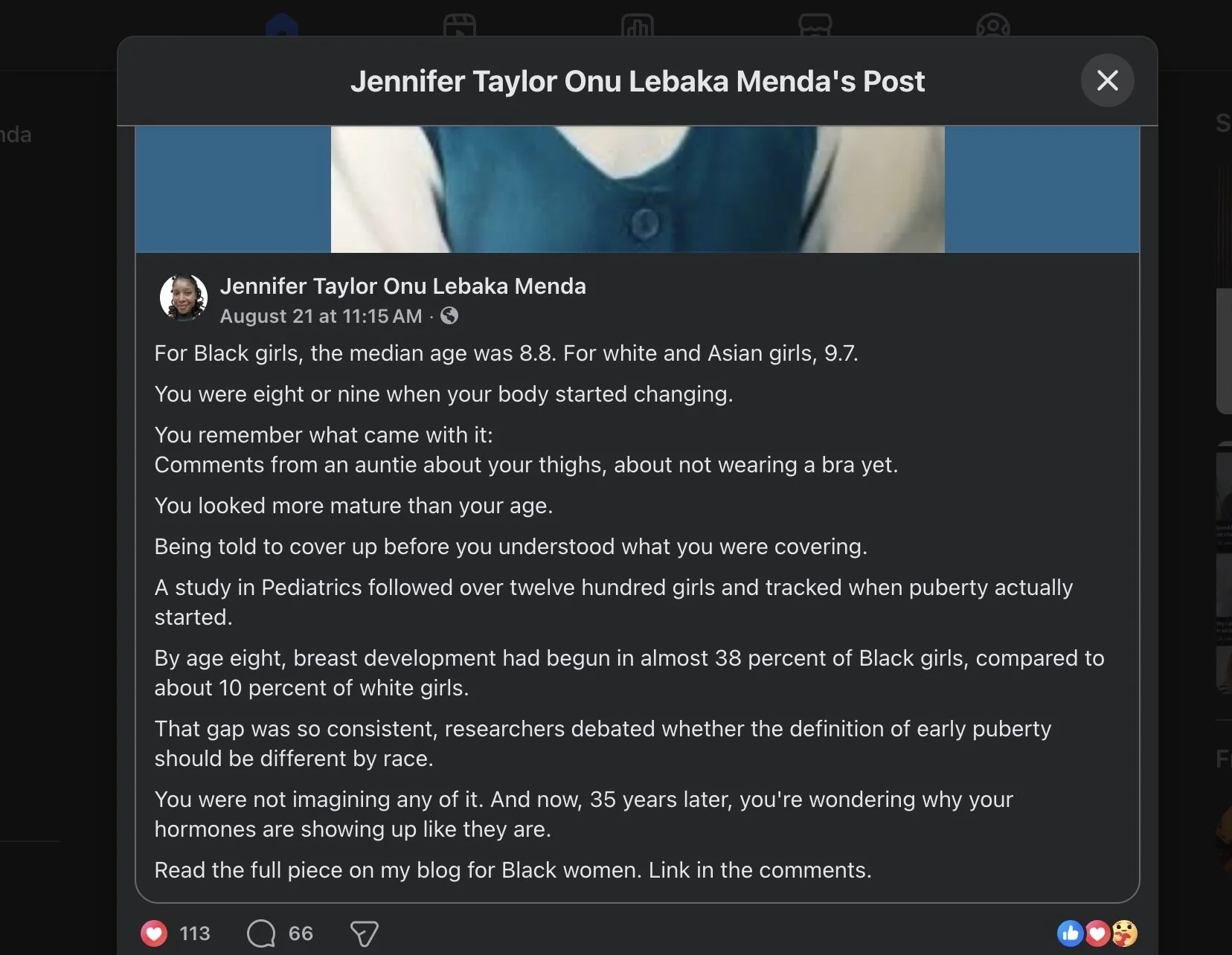
Woman after woman brought up body fat. Specifically, that how much fat a girl is carrying is one of the things that decides when her period starts. Somebody asked the question directly: what does fat have to do with any of this, and does that mean it is still doing something now, in our forties?
That is a real question and it deserves a real answer, so I want to take it seriously instead of skimming past it.
This is not going to be a piece about losing weight.
Fat is not a mistake your body made.
In the story I am about to tell you, it is one of the most intelligent tissues you have.
Read it as biology, not as a verdict on your body.
The threshold nobody explained to us
In the 1970s, a researcher named Rose Frisch proposed something that sounded strange at the time. She argued that a girl's body will not begin menstruating until it reaches a minimum percentage of body fat, and that it needs a slightly higher percentage than that to keep menstruating regularly. Her numbers were roughly 17 percent body fat to start a cycle, and about 22 percent to sustain one.
Decades of research since then have refined the details, but the core of it held up. Girls who are significantly underweight, who train at an elite athletic level, or who are malnourished tend to start their periods later, or lose them once they have started.
This is why competitive gymnasts and ballet dancers were some of the first populations where doctors noticed the pattern clearly.
Their bodies were not choosing to delay puberty. Their bodies did not have enough stored fuel to risk it.
That word, risk, is doing real work in that sentence, and I want to slow down on it.
What fat is actually saying
For a long time, doctors assumed body fat was just a passive fuel tank, calories in storage and nothing more. Then in 1994, researchers identified a hormone made almost entirely by fat cells, and it changed the entire field.
That hormone is leptin.
Leptin is not incidental to reproduction. It is one of the primary signals the body uses to decide whether reproduction is safe to attempt. Fat cells release leptin in proportion to how much fat you are carrying, and leptin travels to a cluster of neurons in the hypothalamus that also receive signals from a second messenger called kisspeptin.
Together, they control the pulsing release of gonadotropin releasing hormone, which is the signal that starts the entire cascade toward a menstrual cycle. Below a certain leptin threshold, that pulse generator stays quiet.
The body will not spend resources on a pregnancy it cannot afford to sustain.
This is not a metaphor. This is a literal accounting system, run by adipose tissue, reporting to the brain on whether there is enough reserve to support a fetus. Fat is not sitting there being lazy.
It is doing surveillance and reporting back.
Where race enters this conversation again
A 2001 study in Pediatrics looked directly at whether rising body mass index could explain why Black girls were reaching puberty earlier than white girls. The researchers found that yes, higher BMI was clearly associated with earlier puberty, and BMI had been climbing across the population. But when they controlled for BMI and still looked at the racial gap, it did not close.
Their own conclusion was that something else, genetic or environmental, was still needed to explain the rest of the difference.
That finding means fat is not a competing explanation to what I wrote about last time. It is a second channel carrying some of the same signal.
Chronic stress raises cortisol.
Cortisol promotes the storage of fat specifically in the visceral, central pattern, and it also interferes with how sensitively the brain responds to leptin. So a body under sustained vigilance, the kind I described in the last piece, is not just running a stressed nervous system. It is also being pushed, hormonally, toward a body composition that leptin reads as ready.
Two separate systems, stress physiology and fat physiology, converging on the same outcome from different directions. That is what a body under real pressure actually does.
Forty years later, fat changes jobs
Now here is the part that answers the second half of the question, the part about perimenopause.
For most of your reproductive years, your ovaries are the primary factory for estrogen.
Fat tissue makes a small amount too, through an enzyme called aromatase, which converts circulating androgens into estrogen, but it is a minor contributor while the ovaries are running at full output.
As you move through perimenopause and your ovarian estrogen production becomes erratic and then declines, something shifts.
Fat tissue does not stay idle. Aromatase activity in adipose tissue becomes a genuinely significant source of estrogen, specifically a form called estrone, at exactly the moment your body needs a backup supply.
This is not enough to fully replace what the ovaries were making.
But it is not nothing, and it explains something clinicians have documented for years: as estrogen from the ovaries falls, fat distribution itself changes, shifting from the hips and thighs toward the abdomen, as the body reorganizes where it is keeping its new primary estrogen-producing tissue.
That shift in where you carry weight in your forties is not random and it is not a personal failing. It is your body relocating its remaining estrogen factory to keep the lights on a little longer.
What the Spleen has always governed
The Spleen, it does not map cleanly onto the anatomical spleen you learned in a biology class. This framework was written centuries before anyone had a microscope, a hormone assay, or a word like aromatase.
That gap in vocabulary never meant the mechanism was not already there. It meant the physicians observing it had to describe what a body was doing in the only language available to them at the time, and that description has held up.
In Chinese medicine, the Spleen governs transformation and transportation.
That is the literal function.
Food comes in, and the Spleen is responsible for transforming it into Qi and Blood, the two substances every other organ system depends on to function.
The Spleen is also described as governing the flesh, the muscle tissue and the tissue that pads and protects the body. When Spleen function is strong, transformation is clean and efficient. Qi and Blood get made well, and what is left over does not accumulate anywhere it should not.
When Spleen Qi is weakened, whether from years of poor rest, from worry, which is the emotion classically associated with this organ, or from something else entirely, transformation slows down. What the body cannot fully transform does not just disappear. It accumulates as what this medicine calls Dampness, a heavy, sluggish quality that shows up as bloating, fatigue, a swollen or puffy tongue, and yes, a pattern of weight gain that feels disconnected from what you are actually eating.
The Spleen does not work in isolation.
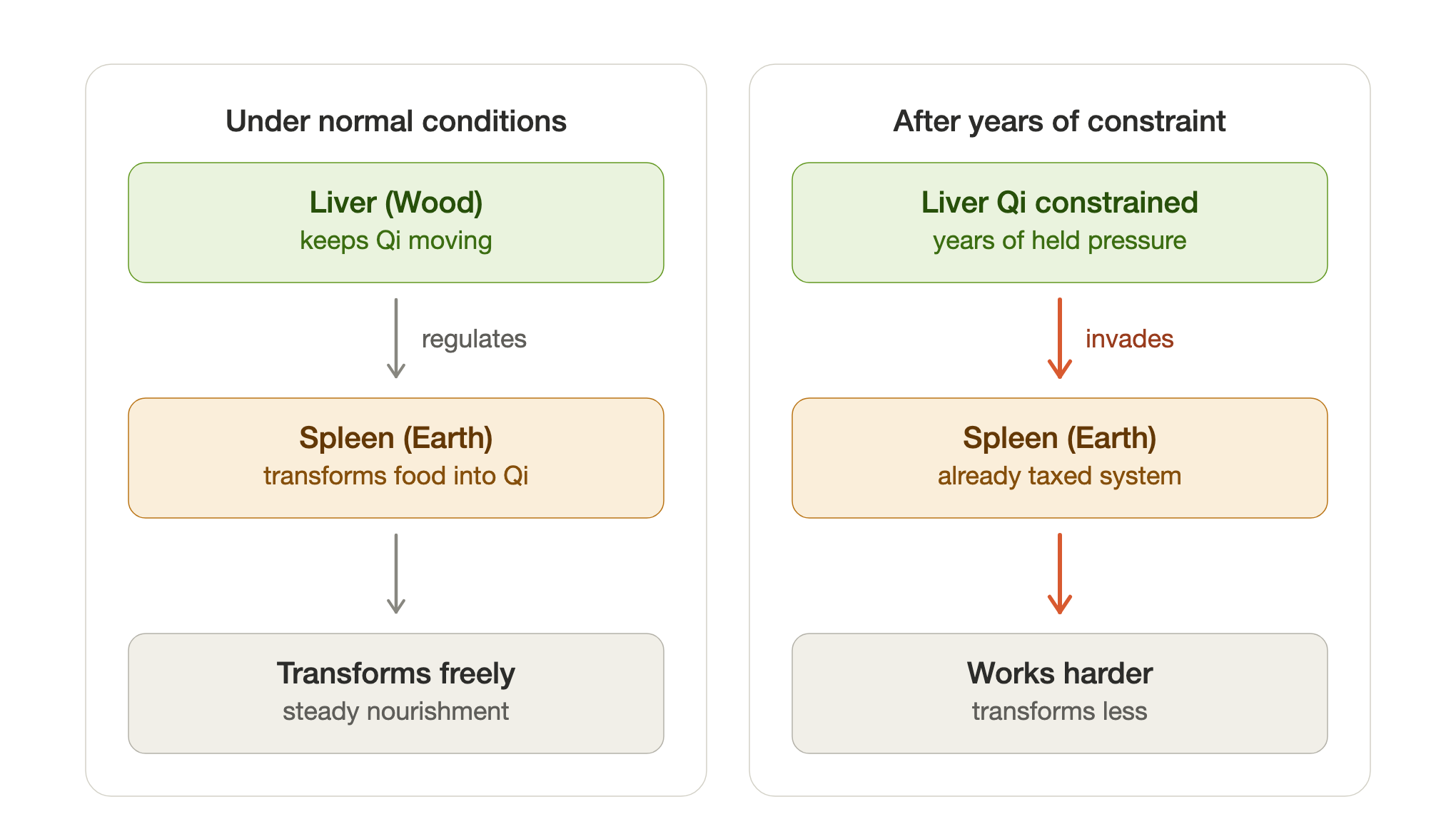
In the five element framework, Wood controls Earth, meaning the Liver is meant to have a regulating, balancing relationship with the Spleen under normal conditions.
But when Liver Qi has been constrained for years, which is exactly the pattern I described in different piece, that regulating relationship can turn into something closer to an assault. Practitioners call this the Liver invading the Spleen.
Liver Qi stagnation does not stay contained. It pushes into the Spleen's territory and makes an already taxed system work harder to transform less.
Why this matters for the whole arc
Put the two pieces of this series together and something clicks into place.
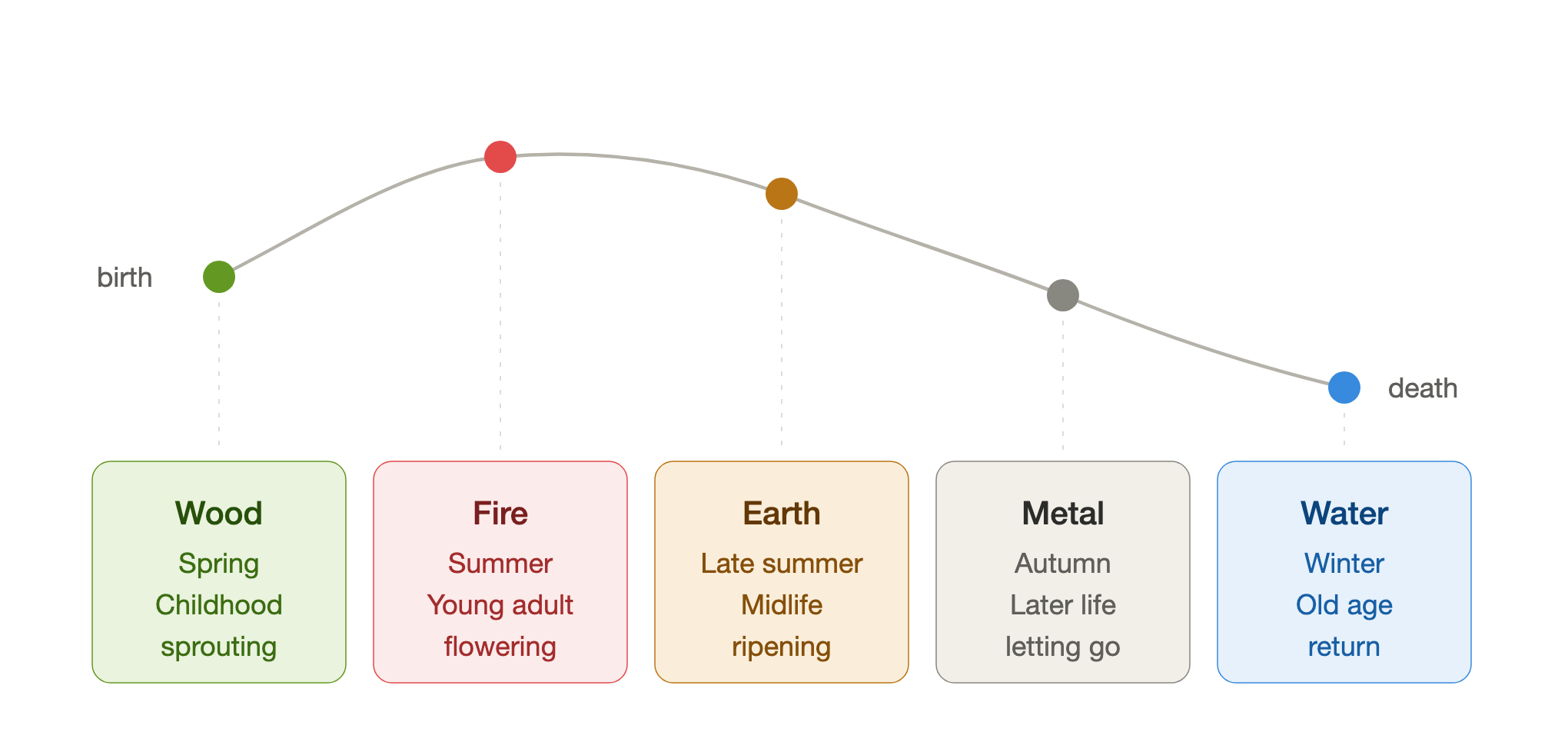
The Liver has been carrying load since childhood.
Kidney essence, the deep reserve, has been drawing down the entire time in between. And now, in perimenopause, the Spleen is being asked to do more, not less.
It has to keep producing enough Blood to nourish a Liver that is already strained, at the same moment your body is leaning on fat tissue to manufacture a backup supply of estrogen the ovaries can no longer fully provide. That is two demands landing on one organ system at once, and that organ system may have been quietly losing ground to Liver invasion for years before you ever noticed.
This is why so many women describe new abdominal weight, bloating, and a general sluggishness in perimenopause that does not track with any change in how they eat.
It is not a discipline problem.
It is Spleen transformation, already under strain from a Liver that has been under load for decades, now asked to help carry an entirely new kind of biological work.
What to do with this
I want to be very clear about what I am not saying. I am not saying lose the weight and your symptoms will resolve. That framing is exactly the trap I am trying to help you out of.
What I am saying is that the fat itself is not the villain in this story. It has been an intelligent, communicating tissue since before you had a period, and it is still communicating now.
The actual work is supporting the Spleen's ability to transform, and easing the Liver's grip on it, not punishing the tissue that is trying to keep your hormones supplied.
Get real labs if you have not. Rule out thyroid dysfunction, insulin resistance, and anemia, because those can mimic or worsen this pattern and they need a physician's eyes on them.
Then find someone who can actually assess whether what you are dealing with is Spleen Qi deficiency with Dampness, Liver invading Spleen, or something else entirely, because the treatment for each of those is different, and none of them start with a calorie count.
Your fat was never keeping score against you. It has been running one of the most sophisticated reporting systems in your body since you were nine years old, and right now it is doing the same job it has always done. Trying to keep you resourced enough to survive the season you are in.
If you want to talk through what your own pattern is telling you, I offer a free 1:1 call.
References
Frisch RE, Revelle R. "Height and weight at menarche and a hypothesis of critical body weights and adolescent events." Science. 1970;169(3943):397-399. Foundational statement of the critical body fat hypothesis, later refined in Frisch RE, McArthur JW, "Menstrual cycles: fatness as a determinant of minimum weight for height necessary for their maintenance or onset," Science. 1974;185(4155):949-951. https://pubmed.ncbi.nlm.nih.gov/4053451/
Chehab FF, Lim ME, Lu R. "Correction of the sterility defect in homozygous obese female mice by treatment with the human recombinant leptin." Nature Genetics. 1996;12(3):318-320. Early evidence establishing leptin's role in triggering reproductive competence. https://pghn.org/DOIx.php?id=10.5223/pghn.2012.15.3.151
Shalitin S, Phillip M. "Role of obesity and leptin in the pubertal process and pubertal growth: a review." International Journal of Obesity. 2003;27:869-874. https://www.nature.com/articles/0802328
Kaplowitz PB, Slora EJ, Wasserman RC, Pedlow SE, Herman-Giddens ME. "Earlier onset of puberty in girls: relation to increased body mass index and race." Pediatrics. 2001;108(2):347-353. https://pubmed.ncbi.nlm.nih.gov/11483799/
Davison KK, Susman EJ, Birch LL. "Percent body fat at age 5 predicts earlier pubertal development among girls at age 9." Pediatrics. 2003;111(4):815-821. Establishes that body fat precedes and predicts pubertal timing, supporting a causal rather than incidental relationship.
Newell-Fugate AE, et al. "Metabolic impact of endogenously produced estrogens by adipose tissue in females and males across the lifespan." PMC.https://pmc.ncbi.nlm.nih.gov/articles/PMC12575157/
"Estrogen Metabolism in Abdominal Subcutaneous and Visceral Adipose Tissue in Postmenopausal Women." Journal of Clinical Endocrinology & Metabolism. 2017;102(12):4588-4595. On aromatase activity and estrone production in adipose tissue after ovarian estrogen decline. https://academic.oup.com/jcem/article/102/12/4588/4210386
"The Regulation of Adipose Tissue Health by Estrogens." Frontiers in Endocrinology. 2022. On the shift from gynoid to android fat distribution as estrogen declines. https://www.frontiersin.org/journals/endocrinology/articles/10.3389/fendo.2022.889923/full