Your Body Started This When You Were Eight
You were eight or nine when your body started changing.
You remember what came with it. Little comments from your aunt about your thighs, or the fact you're not wearing a bra yet. The way rooms adjust around you cause you look older or taller than your age. Being told to cover up before you understood what you were covering.

Me around 2nd or 3rd grade
You were not imagining that, and you were not developing "early" against some neutral standard. You were living inside a documented pattern that nobody explained to you then, and that almost nobody connects to what your body is doing now, 35 years later.
I want to connect it for you, sis.
The numbers
A study published in Pediatrics in 2013 followed more than twelve hundred girls and tracked when breast development began.
The median age was 8.8 years for African American girls. It was 9.3 for Hispanic girls, and 9.7 for white and Asian girls.
By age eight, breast development had begun in 37.8 percent of Black girls, compared to 10.5 percent of white girls. That is wild to me, and it means physical puberty for well over a third of Black girls is arriving at an age most people still think of as early childhood.
Earlier work using national survey data found the same direction for age at first period. Non-Hispanic Black girls were consistently earlier.
The gap was so consistent that researchers openly debated whether the clinical definition of precocious puberty should be different depending on a girl's race.
The American Academy of Pediatrics pushed back on that, and they were right to. If you set a separate, earlier cutoff for what counts as "too early" in Black girls, you stop flagging cases that need medical attention, and you stop asking the harder question, which is why the timeline moved in the first place. When you change the ruler instead of asking why the measurement moved, you have decided the difference is biological before you have any evidence that it is. That decision closes the investigation. It also has a long and ugly history in American medicine, which we can talk about another day (pending a blog on that!).
The difference is not biological. Look at what actually predicts it.
What predicts it
Researchers have also asked what predicts the age a girl's puberty begins, and the answers point toward environment rather than biology.
A large Kaiser Permanente study followed girls from infancy and found that living in an unstable household before age two, meaning frequent changes in who was in the home, moves, or shifts in caregiver structure, predicted earlier puberty later on. The effect was strongest among Black girls. Neighborhood disadvantage predicted earlier onset too, even after researchers accounted for the mother's own health and characteristics.

My daughter and I
Why researchers zero in on age two is its own field. The theory here is called life history theory, and it holds that a young body reads its earliest environment for cues about how stable or risky the world is, then sets its own developmental timeline accordingly. An environment that reads as unstable can accelerate a girl toward reproductive maturity earlier, because in evolutionary terms, waiting would have been the riskier bet. That theory does not require your two-year-old self to have made a conscious choice. It describes something more automatic than that, a body calibrating itself the way it calibrates to altitude or to cold.
If that theory holds, you would expect one thing to reliably protect a girl: financial stability. Money tends to buy a steadier household, a safer neighborhood, fewer disruptions. That is exactly what researchers found, for white girls. Higher household income protected white girls from early first periods.
It did not protect Black girls. Among Black girls, the highest income quartile was associated with roughly twice the odds of early menarche.
Read that again, cause it undoes something you were probably taught. If money bought safety the way the theory predicts, wealthier Black families should look like wealthier white families in these numbers. They do not. That gap is the finding I have not been able to put down, because it means whatever is accelerating these girls' bodies is not simply a lack of resources. It travels with something else, something that does not disappear when a family has money, and for a Black girl growing up in this country, that something is very often proximity: being the only one in more rooms, at a younger age, for longer, as a family moves into whiter, higher income spaces.
I want to be precise here, because you should be able to repeat this and defend it at a dinner table. A meta-analysis of forty three studies looked at whether adverse childhood experiences, tallied as a lump total the way most trauma research counts them, predicted early puberty. As a lump sum, they did not. But when researchers broke that total apart into its individual pieces, specific experiences did predict it, and they did not predict it equally. Father absence had the strongest effect by a wide margin. Family dysfunction and abuse had smaller effects.
So it is not that hardship in general speeds up a girl's body. It is that particular kinds of instability, the kind a young nervous system reads as a signal about an uncertain future, do the accelerating. That distinction matters. It is the difference between a real, mechanistic finding and a slogan about trauma, and it is the difference between telling a woman "your childhood was hard, that explains it" and telling her "your body was tracking something specific, and here is what."
Forty years later, the same organ
Here is where Chinese medicine says something no lab panel will tell you.
In this system, puberty and perimenopause are the same event running in opposite directions.
Both are governed by Kidney essence, which is the deepest constitutional reserve you have, the closest thing this medicine has to a savings account you were born with. Both are managed by the Liver, cause the Liver stores the Blood and moves the Qi, the intelligent function, that regulates a cycle.
The classical line comes from Ye Tianshi, a Qing dynasty physician writing in the 1700s, in his case records. He wrote that women take the Liver as their foundation, and that line became a guiding principle for how this medicine treats women's health in the centuries since, long before anyone had measured a hormone.
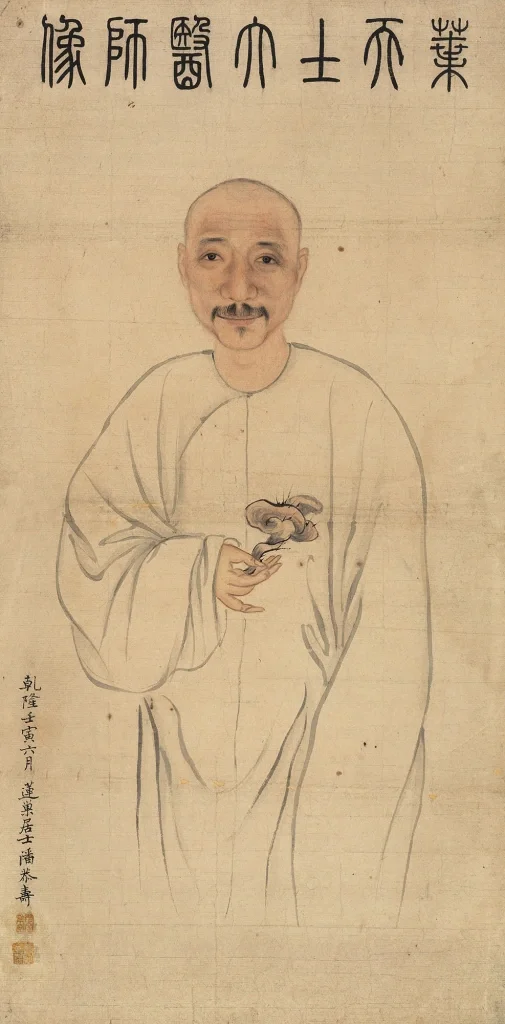
Which means the organ system that opened your cycle is the same one now trying to close it, and it has been carrying load the entire time in between.
That is the sentence I want you to sit with, not because it is poetic, but because it reframes what perimenopause actually is.
What the load has been
Public health researchers have a name for a particular kind of chronic load. They call it vigilance, or anticipatory vigilance. It describes the mental and physical work of preparing for possible discrimination before it happens.
Margaret Hicken and colleagues published in the American Journal of Public Health in 2014 using a population-representative Chicago sample of about three thousand adults. Black adults reported the highest levels of vigilance. Among Black adults, higher vigilance was associated with higher odds of hypertension. Among white adults in the same sample, there was no such association.
Work from that same research line found vigilance helped explain Black and white differences in sleep difficulty. A later study found it related specifically to waist circumference in Black women. That means blood pressure, sleep, and the size of a woman's midsection, three of the things you are currently fighting, all show up in a literature connecting them to something you have been doing since childhood without ever calling it anything.
Arline Geronimus named this weathering back in 1992. The argument is that health deteriorates earlier from accumulated adversity rather than from any single event. In 2006 she and her colleagues found Black women carried the highest allostatic load of any group studied, and that poverty did not explain it. Nonpoor Black women were still near the top.
Nancy Krieger at Harvard calls the broader process embodiment. Her definition is that we literally incorporate, biologically, the world we live in.
I am going to name the limits here, because I would rather you trust me than be impressed by me. These are observational studies. They demonstrate association and a consistent pattern across three decades and multiple research groups. They do not isolate a single clean cause, and effect sizes vary between samples.
But the pattern points somewhere specific, and it points there repeatedly. A stress system that was never permitted to fully stand down, running since before you had language for it.
Why this changes what perimenopause is
Here is the reframe, and it is the reason I am writing this instead of another article about sleep hygiene.
You have been told perimenopause is a hormone problem that begins in your forties.
What the evidence actually describes is a system that has been under sustained load since childhood, arriving at the one transition that removes its remaining margin.
Progesterone drops earlier and harder than estrogen in this season. Progesterone was supporting your GABA receptors, which run your brain's main calming system. Estrogen is swinging rather than declining smoothly, and estrogen influences serotonin, melatonin, and your circadian timing. So the buffers come down, and what was underneath the buffers is not new. It has been there the whole time.
That is what a root cause looks like. Not the thing that started in 2023 when you first noticed the 3am waking. The thing that has been running since you were eight and finally became impossible to ignore.
In Chinese medicine terms, this is a Liver that has been constrained for decades, holding Qi that cannot settle. Yang rises at night when it should be descending, because there is not enough Yin reserve left to anchor it.
You do not treat that with a sleep aid.
What to do with this
Stop treating your symptoms as a list of separate malfunctions.
The 3am waking, the irritability that surprises you, the bloating that tracks with your week rather than your food, the breast tenderness, the cycles that changed. In a lab those are five complaints across four specialists who have never spoken to each other.
In this medicine that is one pattern with a name, and the name tells you what to do next.
Get the workup. I mean that. Thyroid disease, anemia, and depression share symptoms with everything I just described and they need to be ruled out by a physician.
Then go find someone who reads patterns and not just panels. I read patterns for a living, and it changes what a treatment plan actually addresses.
And stop asking your body to justify itself with a number.
You were not too much at nine.
You are not too much now.
Your body has been keeping a record this entire time. Perimenopause is where that record finally surfaces.
If you want to talk through what your own pattern is telling you, I offer a free 1:1 call. [LINK]