Acupuncture is for Black Women: What the Research Says (and What It Doesn't)
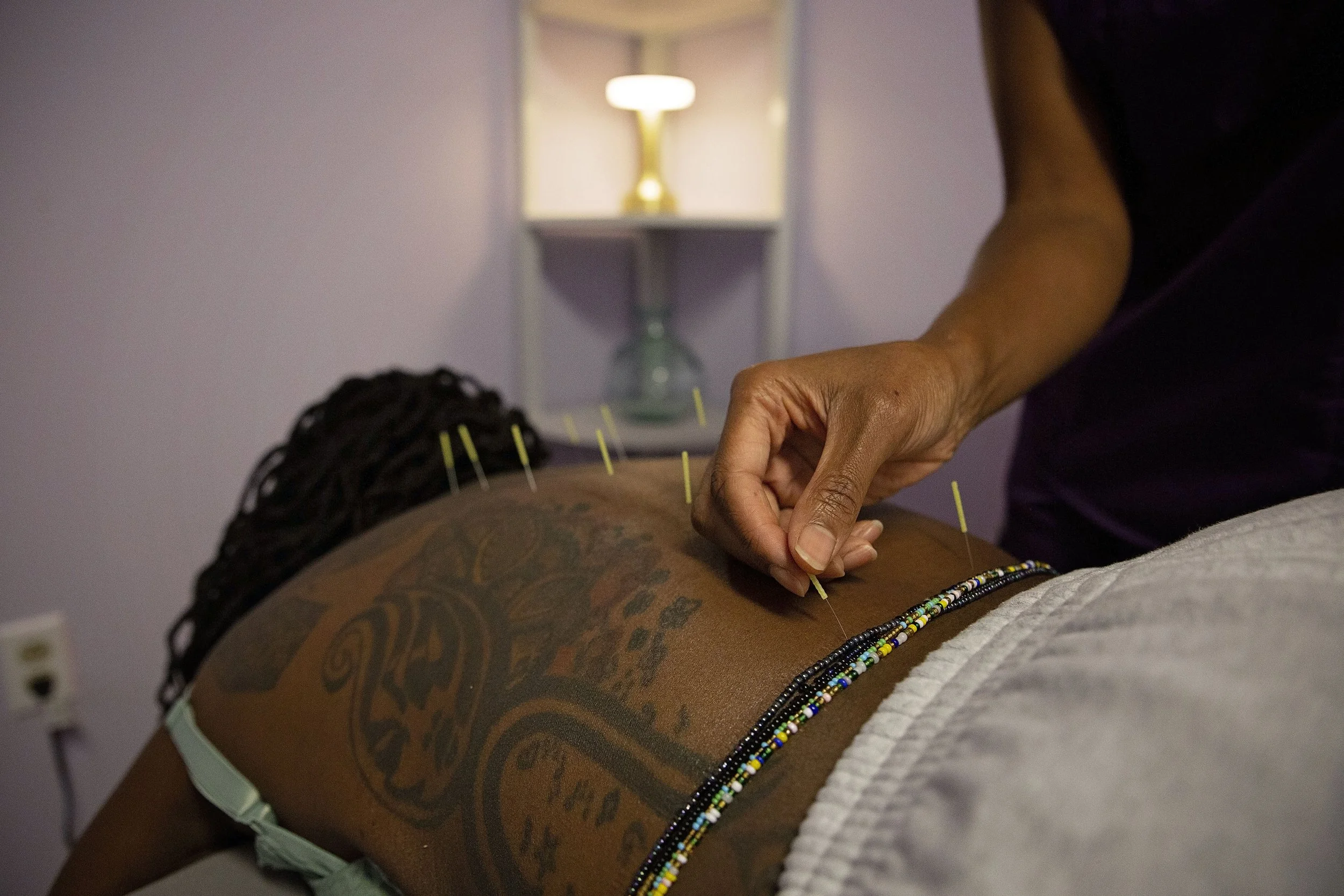
You've probably heard by now that acupuncture "works." Maybe a friend swore by it for her migraines. Maybe you read something about it for fertility. Maybe you've been curious for years and just haven't made the appointment.
Here's what nobody tells you: acupuncture works differently depending on who's receiving it — and the current research on acupuncture for Black women is just beginning to catch up to what Black practitioners have known for decades.
This blog post is about that gap.
And about what becomes possible when it closes.
WHY BLACK WOMEN ARE SEEKING ACUPUNCTURE — AND WHY THEY SOMETIMES DON'T COME BACK
Black women are seeking acupuncture for a specific, overlapping cluster of conditions: fibroids, menstrual pain, anxiety, chronic fatigue, insomnia, and the kind of exhaustion that doesn't resolve with sleep. These aren't random. They're the physical signature of a nervous system that has been running in survival mode for a long time. Mostly because of constant hypervigilance due to systemic racism.
A 2006 survey published in the American Journal of Public Health found that Black women reported lower rates of acupuncture use than other racial groups — not because of disinterest, but because of access, cost, and something harder to name: the sense that this kind of care wasn't designed for them.
That sense is accurate.
Most acupuncture training does not address the specific health patterns that show up in Black patients. Practitioners are taught to assess each person as an individual, which sounds equitable — but when you ignore population-level patterns shaped by centuries of structural stress, you miss the diagnosis.
What you find in the room instead: a patient who doesn't believe she deserves to be well. A nervous system that can't fully receive treatment. A body that holds the tension of being dismissed so many times that it braces even when care is being offered.
WHAT TRADITIONAL CHINESE MEDICINE ACTUALLY HAS TO SAY ABOUT THIS
This is where it gets clinically interesting.
Traditional Chinese Medicine has frameworks for exactly what chronic stress, emotional suppression, and systemic deprivation do to the body. The Spleen system governs nourishment — physical and emotional. When the Spleen is chronically depleted, you see: fatigue that doesn't respond to rest, digestive irregularities, a tendency to worry, difficulty receiving.
The Heart system governs the spirit — the shen — and its connection to joy, intimacy, and the ability to feel safe. When Heart Qi is disrupted, you see: insomnia, palpitations, anxiety, emotional disconnection, difficulty feeling pleasure.
These are not abstract patterns. They are what show up, statistically and clinically, in Black women navigating a healthcare system that has consistently failed them.
The research is beginning to confirm what TCM theory predicts. A 2024 study published in Cancer Medicine found that acupuncture produced greater reductions in insomnia severity among Black cancer survivors compared to white survivors.
Translation—> Black women may actually respond more strongly to this medicine.
The barrier isn't biology. It's access and trust.
THE SPECIFIC THINGS ACUPUNCTURE CAN ADDRESS
For Black women specifically, acupuncture has documented effectiveness for:
Fibroids and menstrual pain.
Fibroids affect Black women at two to three times the rate of white women and develop earlier and more severely. Acupuncture works by improving pelvic circulation, regulating the Chong Mai (the TCM vessel most associated with uterine function), and reducing the inflammatory load that drives fibroid growth.
Anxiety and nervous system dysregulation.
Not the anxiety of a single stressful event — the chronic, low-grade hypervigilance of navigating racism daily. Researchers call this Racial Battle Fatigue. TCM calls it Liver Qi stagnation and Heart Qi deficiency. The points are specific. The results are real.
Fatigue that doesn't resolve with rest.
This is Spleen Qi deficiency — the body's inability to convert input (food, rest, nourishment) into energy. It's common in people who give without receiving, who carry more than their share, who have not had the experience of being cared for without condition.
Sleep.
The 2024 research on Black cancer survivors finding stronger acupuncture response for insomnia is one data point. Clinically, this pattern holds. When the shen settles, sleep follows.
WHAT HAS TO BE DIFFERENT IN THE ROOM, THOUGH
A skilled acupuncturist can needle the correct points and still miss the patient.
What makes acupuncture effective for Black women isn't just technical accuracy — it's what happens in the intake, in the pacing, in how the practitioner holds the space. Does she ask about stress and mean it? Does she follow the thread when the patient says something important, or redirect to the intake form? Does she understand that a Black woman who says "I'm fine" in a medical context has almost certainly been dismissed before — and is watching to see if this time will be different?
The treatment plan matters. The relationship matters more.
If you have had a session that worked and didn't come back — you are not alone, and it is not because you are resistant to healing. Sometimes the medicine was right and the container wasn't. You deserve both.
HOW TO FIND ACUPUNCTURE CARE THAT SEES YOU
First of all, a practitioner who is technically skilled but hasn't examined their own assumptions about race, stress, and the Black body will miss things. Back in 2020, I produced a series of videos on healing presence specifically for acupuncturists treating Black patients, because I watched too many of my colleagues needle the right points and still leave the patient feeling unseen. That work has grown into a full continuing education course, Racial Healing for Acupuncturists, and it is nearly ready. If you are looking for a practitioner who has done this kind of work, you can share that course with them directly [link coming soon]. If you are a practitioner reading this, this is your invitation. Knowing the points is not enough. Knowing the patient is the practice.
Also, ask before you book. Call or email and ask the practitioner: "Do you have experience working with Black women specifically? How do you approach racial health disparities in your practice?" The answer will tell you everything.
Look for practitioners who look like you or have specific training.
Community acupuncture clinics offer sliding-scale treatment in group settings — often 5–40 per session. These were pioneered in part by social justice movements. The model exists because someone understood that healing shouldn't require financial sacrifice.
Trust your nervous system's read on a practitioner. If you leave a session feeling unseen, that's information. It doesn't mean acupuncture doesn't work for you. It means that particular practitioner wasn't the right fit.
A NOTE ON WHAT "WORKING" LOOKS LIKE
One of the patterns I see most often in my practice: a Black woman comes in, has a session that is extraordinarily effective, and doesn't come back.
Not because it didn't work. Because it worked too well — and something in her doesn't believe she deserves to feel that good.
That belief is worth examining. It's not personal weakness. It's a learned response to a world that has offered Black women care conditionally, or not at all. TCM has a clinical framework for it. The treatment addresses it directly.
You came here because something in you is ready. That readiness is worth following.
-
Liou, K. T., Garland, S. N., Meghani, S. H., Kaye, N. M., Thompson, E., Li, Q. S., & Mao, J. J. (2024). Racial differences in treatment adherence and response to acupuncture and cognitive behavioral therapy for insomnia among Black and White cancer survivors. Cancer medicine, 13(16), e7344. https://doi.org/10.1002/cam4.7344
Upchurch, D. M., Burke, A., Dye, C., Chyu, L., Kusunoki, Y., & Greendale, G. A. (2008). A sociobehavioral model of acupuncture use, patterns, and satisfaction among women in the United States, 2002. Women's health issues : official publication of the Jacobs Institute of Women's Health, 18(1), 62–71. https://doi.org/10.1016/j.whi.2007.08.003